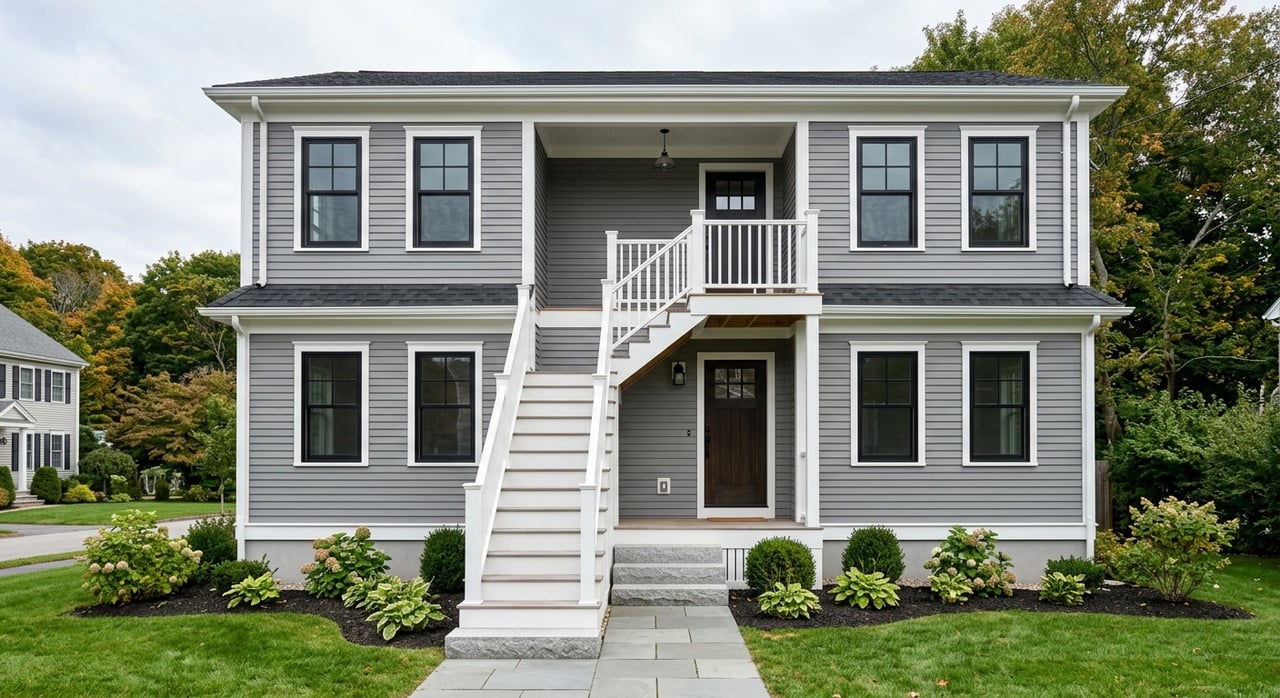
Mansfield MA Multifamily Investment and Rental Potential
June 11, 2026
June 11, 2026
If you are looking at Mansfield for multifamily or rental property, the first question is not just whether rents are strong. It is whether the town’s zoning, pricing, and housing stock actually support the kind of investment plan you have in mind. In a market like Mansfield, careful analysis matters more than broad assumptions, and that is where a disciplined approach can protect you from expensive mistakes. Let’s dive in.
Mansfield is an ownership-leaning market with an estimated population of 24,236 and 9,146 households as of July 2025. About 73.1% of homes are owner-occupied, which tells you this is not a town built around a large renter base. That does not mean rental opportunities are absent, but it does suggest that investor success usually depends on select property types and strong execution.
The town also reflects relatively high household income and home values. Median household income is $125,273, median owner-occupied home value is $603,500, and median gross rent is $1,803. In simple terms, Mansfield is not a low-cost market where easy cash flow tends to appear on paper.
For many buyers, that means the investment story is less about chasing high yield and more about creating value legally and thoughtfully. Small multifamily, long-term rental planning, and selective repositioning tend to make more sense here than aggressive assumptions.
Mansfield’s zoning framework makes one thing clear: this is still fundamentally a single-family-oriented town. The residential districts are R1, R2, and R3, and single-family dwellings remain the baseline use pattern across much of the community.
That matters because legal multifamily opportunities are not spread evenly across town. According to the town’s zoning materials, a two-family standard appears only in R3, at 7,500 square feet per unit. If you are searching for a classic small multifamily acquisition, you will likely need to be selective about both parcel location and existing legal use.
This is one of the biggest reasons Mansfield requires careful due diligence. A property that looks like a promising conversion candidate may not support your intended use once zoning, lot size, parking, septic, and permitting are reviewed.
If your goal is a legal two-family property, R3 is the district that deserves close attention. That does not mean every parcel in R3 will work for your plan, but it is one of the few places where small-scale multifamily possibilities align more directly with the zoning structure.
For an investor or house-hacker, that can make R3 inventory especially valuable. In a town with limited multifamily pathways, legally compliant two-family opportunities can stand out more than they would in a broader rental market.
The clearest multifamily node in town is the Mansfield Station Revitalization Overlay District, or MSROD. This roughly 64-acre area near the commuter rail station is intended to support transit-oriented development, a mix of housing types, and mixed-use activity.
Within the overlay, multi-family housing, mixed-use, and rowhouse or townhouse development are allowed by right with site plan approval. Developments with 20 or more residential units require a special permit, except in the TOD zone. If you are evaluating larger-scale rental or redevelopment potential, this is one of the most important locations in Mansfield to understand.
For many small investors, the most realistic path may not be a traditional multifamily purchase at all. Mansfield allows accessory dwelling units, or ADUs, by right in all residential districts and in several business and industrial districts. These units may be attached, internal, or detached.
That creates a meaningful value-add lane for owners who want long-term rental income without forcing a use that the zoning does not support. The town states that ADUs may be rented long term, but not used as short-term rentals like Airbnb. For some buyers, that makes an ADU strategy more practical than waiting for a rare two-family listing.
Public rent benchmarks for Mansfield vary depending on the source and methodology. The Census Bureau’s 2020 to 2024 estimate shows a median gross rent of $1,803, while Zillow reported an average asking rent of $2,741 as of April 30, 2026.
Those numbers are not directly comparable. Census gross rent and asking-rent data measure different things, so they should be used as directional inputs rather than treated as interchangeable. Still, together they help frame the rental market as stable enough to study, but not necessarily rich enough to ignore acquisition costs and operating expenses.
A quick screening exercise helps illustrate the point. Pairing Zillow’s typical home value of $715,686 with its average rent of $2,741 produces an implied annual gross rent-to-price ratio of about 4.6%. Pairing the Census median gross rent with the Census median home value of $603,500 produces an implied ratio of about 3.6%.
Those are not cap rates. They do not account for taxes, insurance, repairs, reserves, vacancies, or financing. They simply suggest that in Mansfield, strong investment outcomes often depend on buying well, controlling expenses, and unlocking legal value-add opportunities.
Even a solid plan needs available inventory. Zillow reported 26 for-sale listings and 15 new listings in Mansfield as of April 30, 2026. That figure reflects the overall market rather than just multifamily, but it still points to a practical challenge: acquisition opportunities may be limited.
When supply is tight, your buy-box needs to be clear. You may need to decide in advance whether you are targeting a legal two-family, a single-family with ADU potential, an older home with a layout that may support legal conversion, or a site in or near the station overlay.
In a constrained market, discipline often matters more than speed alone. The right strategy is usually to underwrite several realistic paths and move quickly only when a property fits the legal and financial criteria.
A Mansfield rental analysis should start with all acquisition costs, not just the purchase price. That includes closing costs, financing costs, rehab budget, contingency, and lease-up reserves.
On the operating side, your worksheet should account for gross scheduled rent, vacancy and credit loss, taxes, insurance, repairs and maintenance, management, utilities if landlord-paid, legal and accounting costs, and capital reserves. The point is to arrive at net operating income and test how that result holds up under less optimistic assumptions.
This is especially important in Mansfield because the margin for error may be tighter than buyers expect. A decent-looking rent number can lose meaning quickly if renovation costs rise, permit timelines stretch, or expenses were understated.
Mansfield’s FY2026 split tax rate is $13.09 per $1,000 of assessed value for residential property and $19.81 per $1,000 for commercial, industrial, and personal property. For rental underwriting, tax assumptions should be explicit from the start.
This is one of the easiest line items to underestimate when you are focused on rent growth or renovation upside. In a moderate-yield market, taxes can materially shape your true return.
The town’s Public Health Department notes that the state Sanitary Code sets minimum requirements for rental housing. If you are planning to lease a property, compliance is not a side issue. It is part of your operating model.
This becomes more important when you are improving older homes or reworking layouts. A project that looks straightforward on paper may involve added compliance costs before a unit is ready for tenants.
If a property depends on private wastewater systems, septic capacity can become a major factor. Mansfield’s Health Department issues permits for septic systems and Title 5 matters, which can affect conversions, added bedrooms, or expansion plans.
For investors considering legal unit creation, this is one of the most important technical checks. Lot size and floor plan may look favorable, but wastewater constraints can change the economics fast.
Mansfield states that short-term rentals are not permitted in residential zoning districts. That means your default income assumption for most small residential investment scenarios should be long-term leasing.
This is a critical point for underwriting. If a deal only works under a short-term rental model, it may not fit Mansfield’s residential zoning realities.
Based on the town’s zoning framework and market data, Mansfield appears better suited to disciplined small-scale investors than buyers looking for easy multifamily yield. The strongest strategies tend to be specific and compliance-driven.
Here are the most practical paths to evaluate:
Each of these paths requires parcel-level review. The broader lesson is simple: in Mansfield, returns are more likely to come from legal unit creation, selective repositioning, and careful expense control than from assuming large rent-to-price spreads.
Mansfield offers real rental and multifamily potential, but it is a market that rewards precision. Strong household income, commuter access, and a defined station-area overlay create opportunity, yet the town’s single-family orientation and limited inventory mean not every investor play translates well here.
If you are considering a purchase, the smartest approach is to match your strategy to the town’s actual framework. That means checking zoning early, underwriting conservatively, and focusing on properties where legal use and financial logic align.
That is exactly where finance-led real estate guidance can make a difference. If you want help evaluating a Mansfield property, rental scenario, or value-add opportunity, connect with Talib Hussain Realty Group for a strategic conversation.
Stay up to date on the latest real estate trends.


Rooted in trust, expertise, and sincere dedication, Talib brings a lifelong appreciation of what “home” means to every client and every move.